
Micro Optical Elements
- miGIO™-


miGIO™ micro-optical elements are products realized by combining Nippon Sheet Glass's core strengths in materials development, imprint manufacturing technology, and optical design expertise.
They feature high durability, high precision, and excellent mass-production capability, and are compatible with reflow processes up to 330°C.
In addition, sol-gel glass with heat resistance exceeding 500°C is also available.
Nippon Sheet Glass provides end-to-end support, from optical design through mass production, delivering solutions to a wide range of optical challenges.
Examples of Applications
miGIO™ are widely used across various industries--including optical equipment, medical devices, industrial equipment, automotive applications, and optical communications--leveraging their high durability, high precision, and excellent mass-production capability.

Example 1
Projectors
As laser output continues to increase, our high heat‑resistant diffusers are used as an effective solution for speckle reduction.With 97% transmittance, they also contribute to maintaining high projector brightness.

Example 2
Analytical Instruments
Our high-efficiency diffraction gratings, achieving over 90% utilization efficiency, are used in analytical instruments.
Custom products made of glass materials are available, offering high heat resistance and long-term durability.

Example 3
LiDAR
In environments where standard resin materials cannot meet performance requirements, our organic-inorganic hybrid materials and glass materials can be applied.
Manufactured using imprint technology, they enable high-precision mass production.
miGIO™
Micro-Optical Elements

Point 1
Highly Durable Materials
- Nippon Sheet Glass has developed and owns proprietary sol-gel glass and organic-inorganic hybrid materials.
- These materials offer excellent heat resistance, chemical resistance, weather resistance, and low thermal expansion.
- They are compliant with Tecordia standards and compatible with reflow processes up to 330°C.

Point 2
High Precision with Mass-Production Capability
- High Precision with Mass-Production Capability
- Using imprint manufacturing technology with molds, we achieve high quality consistency and excellent scalability for mass production.
- Optical elements can be formed simultaneously over large areas of up to 8 inches.
- Wafer alignment accuracy of ±1 µm or better enables optical elements to be formed only at required locations on the wafer.
Point 3
Advanced Optical Design Expertise
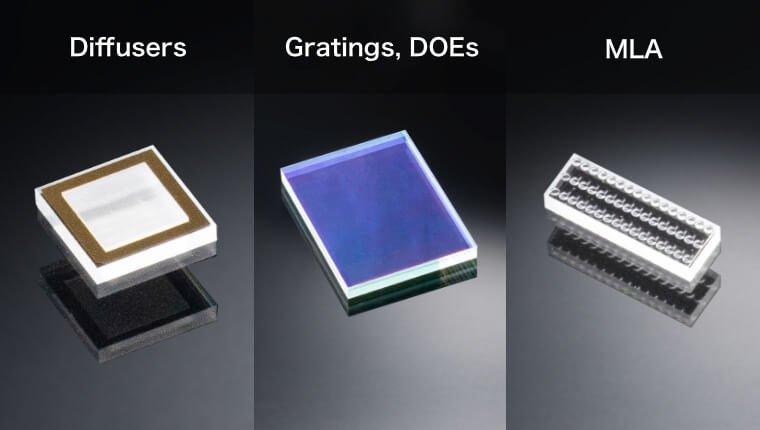
- We offer the design and manufacturing of a wide range of optical elements, including diffusers, DOE (diffractive optical elements), MLAs, and moth-eye structures.
- Our optical design engineers work closely with customers to design optimal optical elements tailored to specific challenges and requirements.
01
Diffuser
Main Specifications of the Diffuser
The basic specifications are outlined below. If you have any requirements beyond these specific
| Organic-Inorganic Hybrid | Sol-Gel Glass | |
|---|---|---|
| Diffusion Angle | Up to approx. 120° | Up to approx. 20° |
| Angular Variation | ±2° (for 70° type) | ±0.2° (for 3° type) |
| Transmittance | Approx. 97% | Approx. 97% |
| Wavelength Range | Approx. 400-2,000 nm | Approx. 200-2,500 nm |
| Heat Resistance | 330°C | 500°C |
| Organic-Inorganic Hybrid | |
|---|---|
| Diffusion Angle | Up to approx. 120° |
| Angular Variation | ±2° (for 70° type) |
| Transmittance | Approx. 97% |
| Wavelength Range | Approx. 400-2,000 nm |
| Heat Resistance | 330°C |
| Sol-Gel Glass | |
|---|---|
| Diffusion Angle | Up to approx. 20° |
| Angular Variation | ±0.2° (for 3° type) |
| Transmittance | Approx. 97% |
| Wavelength Range | Approx. 200-2,500 nm |
| Heat Resistance | 500°C |
These specifications are general and may vary depending on the operating conditions.

Examples of Diffuser Production
Manufactured using glass imprint technology with sol-gel glass or organic-inorganic hybrid materials that offer excellent heat resistance and laser durability.
We also provide optical design support in-house.
In addition, custom development for special applications, such as diffusers with integrated electrodes, is available.

Example of Diffusion Pattern (1)
Circular, 95°, flat-top

Example of Diffusion Pattern (2)
Circular, 50°, batwing

Example of Diffusion Pattern (3)
Rectangular, 82° x 64°, batwing

Example of Diffusion Pattern (4)
Rectangular, 72° x 56°, batwing

Example of Diffusion Pattern (5)
Rectangular, 44° x 16°, flat-top
02
Grating/DOE
Examples of Diffraction Grating Specifications and Production Cases
The examples below show typical specifications and production cases.
We are capable of manufacturing a wide variety of diffraction gratings and DOEs.
Please feel free to contact us regarding custom products or requests beyond the examples shown.
Our high heat‑resistant and highly durable sol‑gel glass is used in devices that operate under high‑temperature conditions.
| Material | Sol-gel glass |
|---|---|
| Minimum Pitch | 190 nm (approx. 5,200 lines/mm) |
| Type | Transmission type, Reflection type |
| Coating | Al, Au, etc. |
| Structure | Blazed, Grating, etc. |
| Substrate | Various types of glass |
| Heat Resistance | 500°C |
| Example 1 | Example 2 | Example 3 | |
|---|---|---|---|
| Line Density (lines/mm) | 300 | 2000 | Pitch: 1μm |
| Type | Reflection type | Transmission type | DOE |
| Coating | Au | - | - |
| Structure | Blazed | Rectangular | 16-step |
| Substrate | Synthetic quartz | Tempax Float® | D263Teco® |
| Utilization Efficiency | 85% | 90% | 80% |
| Example 1 | |
|---|---|
| Line Density (lines/mm) | 300 |
| Type | Reflection type |
| Coating | Au |
| Structure | Blazed |
| Substrate | Synthetic quartz |
| Utilization Efficiency | 85% |
| Example 2 | |
|---|---|
| Line Density (lines/mm) | 2000 |
| Type | Transmission type |
| Coating | - |
| Structure | Rectangular |
| Substrate | Tempax Float® |
| Utilization Efficiency | 90% |
| Example 3 | |
|---|---|
| Line Density (lines/mm) | Pitch: 1μm |
| Type | DOE |
| Coating | - |
| Structure | 16-step |
| Substrate | D263Teco® |
| Utilization Efficiency | 80% |
These specifications are general and may vary depending on the operating conditions.

03
MLA (Micro Lens Array)
Examples of Micro Lens Array (MLA) Production
The examples below illustrate typical production cases; however, we are capable of manufacturing a wide variety of MLAs. Please feel free to contact us for custom designs and requirements.
Production is performed with alignment accuracy of ±1μm or less, and the products are compatible with reflow processes.
They are widely used in various applications, including optical
| Material | Organic-Inorganic Hybrid | Organic-Inorganic Hybrid |
|---|---|---|
| Pitch | 127μm | 250μm |
| Lens diameter | 120μm | 200μm |
| Number of lenses | 1 x 72ch | 2 x 12ch |
| Material | Organic-Inorganic Hybrid |
|---|---|
| Pitch | 127μm |
| Lens diameter | 120μm |
| Number of lenses | 1 x 72ch |
| Material | Organic-Inorganic Hybrid |
|---|---|
| Pitch | 250μm |
| Lens diameter | 200μm |
| Number of lenses | 2 x 12ch |

04
Others
Other Applications of Imprint Technology

Lens on Wafer (LoW)
This technology enables lens formation directly on semiconductor wafers using imprint processes.
It eliminates the need for complex alignment procedures, allows for thin-profile designs, and is compatible with reflow processes.

Precision Structure
Imprint technology can also be applied beyond optical applications to manufacture a wide range of precision components.
This manufacturing method offers excellent mass-production capability, achieving both high precision and high scalability.
Core Technologies
Imprinting is a technology that uses a mold to transfer the shape of the mold onto components.
Imprint Manufacturing Process


(UV curing/Heat curing)


One-Stop Service from Design to Mass Production
Nippon Sheet Glass offers end-to-end support, from optical design through mass production.
In addition to optical element fabrication, we also provide value-added processes, such as AR (anti-reflection) coating on element surfaces.
Design

Optical design
Structural design
Mold

Machining
Laser Patterning
Electron Beam (EB) Writing
Proprietary Materials
High Precision
High Durability
Large-Area Molds
Lens

Shape Accuracy
High Adhesion
Low Residual Stress
High Reliability
Reflow Heat Resistance
Low Water Absorption
Chemical Resistance
Forming

Alignment
Thickness Control
On-Target Forming
Lithography
Double-Sided Forming
Handling

Functional Wafers
Patterned Substrates
Ultra-Thin Substrates
Fragile Substrates
8-Inch Wafers
Additional Processing

Thin-Film Deposition
Dicing/Cutting
Spin Cleaning
Inspection

Optical Performance
Positional Accuracy
Thickness
Appearance
Automated Inspection
Mapping
Design
We provide optical and structural design services tailored to a wide range of customer requirements and specifications..
Mold Fabrication
Molds are fabricated using the most suitable methods to meet specific requirements.High-precision molds can be produced in large formats and offer excellent durability, making them ideal for mass production.
Lens Materials
Our proprietary organic-inorganic hybrid materials enable high-fidelity shape replication and provide excellent durability, including reflow heat resistance exceeding 330°C.
Imprinting/Forming
Optical elements such as lenses can be formed on various substrates, including glass and semiconductor wafers.We can control alignment or form lenses on-target, and the areas where no resin is applied can be freely defined.
Handling
Even patterned functional wafers and thin, fragile substrates can be safely protected and processed.
Additional Processing
We also offer value-added processes such as thin-film deposition, dicing, and cleaning, according to customer requirements.
Inspection
Key inspection items--including optical performance, positional accuracy, thickness, and appearance--are evaluated using automated inspection systems, and the results can be mapped for analysis.
Contact NSG
NSG's micro-optical elements have continuously evolved by responding to market needs and customer requirements.
No matter how challenging the request, we deliver solutions through advanced technology, creating the best outcomes for people and society.
We invite you to contact NSG and discuss your needs with us.